

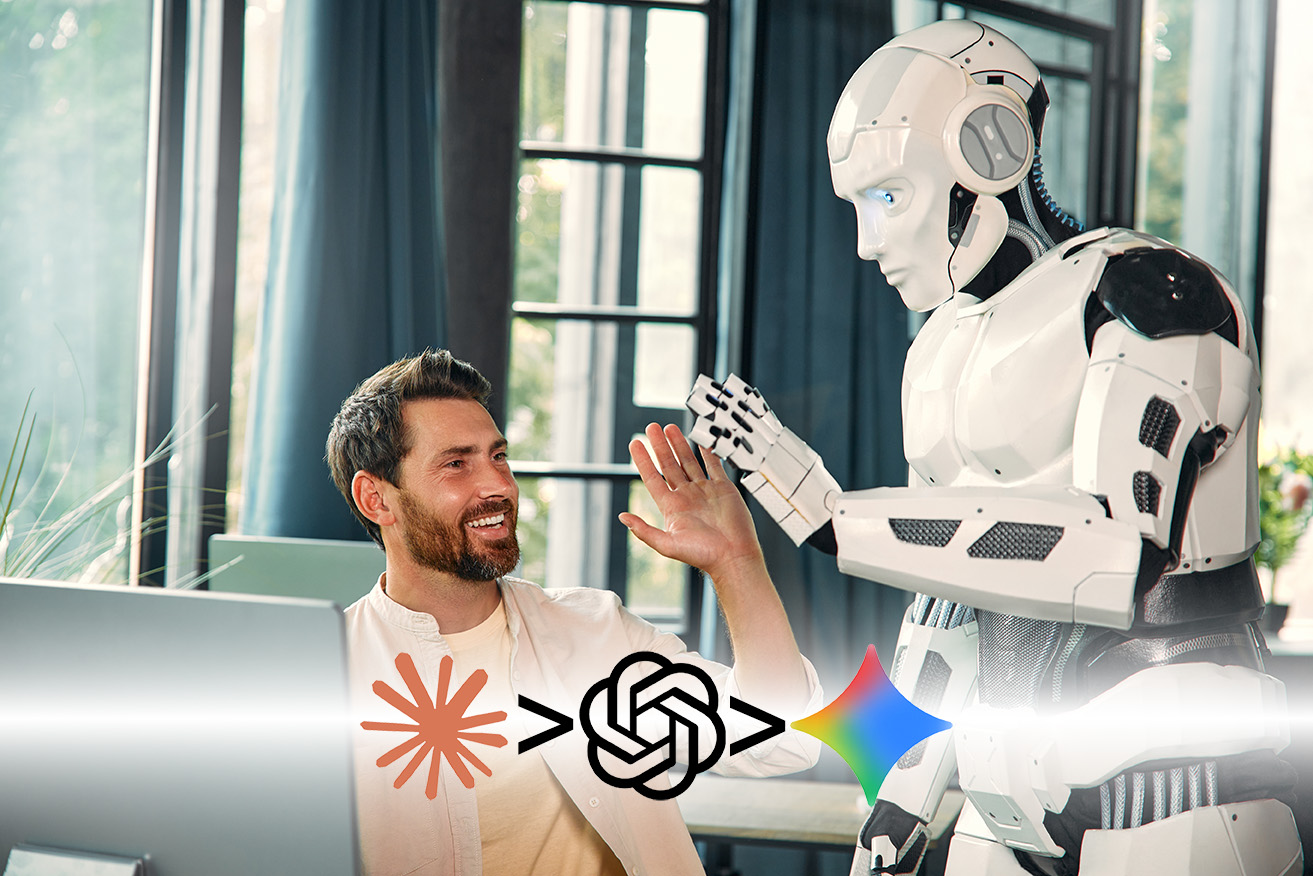
I hold paid subscriptions to all three major AI platforms — Claude, ChatGPT, and Google Gemini. I use them daily across my businesses, and the differences are not subtle. Here's my opinion about where each one wins, where it falls short, and why I rank them how I do.
Let me be upfront: this isn't a hit piece on OpenAI or Google. Every one of these tools earns its keep. I'm not writing this as someone who dabbled for a week with each one. I've run real business workflows through all three, pushed them on writing, strategy, code, technical documentation, client communication, and operations. The ranking reflects a collection of real-world experience, not "popular opinion".
Having all three running simultaneously changes how you see them. You stop treating them like competitors and start treating them like a team with specialized roles. The trick is knowing who to call for what.
Ranked #1
Claude: The One That Actually Thinks With You
I'll say it plainly: Claude is the AI I trust with the work that matters most. When something is going to a client, a board member, or a business partner...when the stakes are real...I'm running it through Claude. Not because the others can't produce good output, but because Claude produces output I don't have to babysit.
The single biggest difference is what I'd call context depth. Claude doesn't just answer the question you asked, it understands and reads deeper into what it's being asked. If I'm drafting a strategic document, Claude will catch a structural gap I didn't mention. If I'm writing a client-facing document, it keeps brand voice consistent across 3,000 words without being reminded. That's not a trick. That's actually understanding context.
Claude holds its reasoning across long conversations better than any other tool I've used. It doesn't lose the thread. It doesn't contradict itself five messages in. For complex work that consistency is everything.
In my technical operations work I'm constantly writing SOPs, drafting project scopes, building out AVL documentation. Claude is the best tool that can take a brain dump and return something genuinely polished on the first pass. Not "pretty good for AI." Actually good.
The writing quality is also in a different league when it comes to tone consistency. Claude understands the difference between writing for a church leadership team, a technology vendor, or a school district. It adjusts without being told twice. That emotional intelligence in communication is underrated and hard to articulate, but it's a real thing.
- Long-form documents, proposals, and reports that require internal logic and consistency
- Strategic communications where tone, nuance, and professionalism are non-negotiable
- Technical documentation — SOPs, scope documents, operational framework
- Complex reasoning tasks where you need it to think, not just retrieve
- Creative work that still needs to serve a business objective
- Conversations where context compounds: multi-session work, ongoing projects
One underrated thing about Claude: it pushes back when it should. If I give it a flawed premise, Claude will tell me, respectfully, but directly. That's not a bug; that's a senior team member. The other two tools tend to comply first and qualify later, if at all. When I need honest analytical feedback before something goes out the door, I want the model that will actually tell me it thinks theres a problem.
Ranked #2
ChatGPT: The Versatile Workhorse
ChatGPT is the oldest, the most recognizable, and, because of that history, the most capable in certain specific domains. It earns its place at #2 by being genuinely excellent at structured, repeatable tasks. It's also the one most people on my team are already comfortable using, which has its own operational value.
Where ChatGPT shines brightest is in its breadth. The plugin ecosystem, the integration capabilities, the ability to browse the web, generate images, and run code in the same conversation — no other platform matches that all-in-one functionality. For rapid brainstorming and exploratory work, that versatility is a genuine advantage.
When I need to go from idea to output fast - research, summarize, draft, visualize - ChatGPT's toolset is hard to beat. It's the Swiss Army knife of the three, and that's not a knock. Sometimes a Swiss Army knife is exactly what the job requires.
For data work specifically, ChatGPT's data interpreter is a legitimate business tool. I can drop in a spreadsheet and get analytics, charts, and formatted output without writing a single formula. That's a real capability that saves real time. It's also more reliable than the other platforms when it comes to following precise formatting instructions on structured outputs like tables, lists, etc. It just gets stuff done.
Where ChatGPT falls behind Claude is in contextual judgment. It's excellent at producing output that is technically correct but occasionally feels templated. You can usually tell when something came out of ChatGPT — not because it's bad, but because it has a certain feel that doesn't always match the voice you were going for. It optimizes for polish while Claude optimizes for authenticity.
- Rapid research and summarization across large volumes of information
- Code generation, debugging, and data analysis via code interpreter
- Image generation for presentations, social media, and client materials
- Structured output tasks — tables, templates, formatted data
- Plugin-driven workflows where it connects to external tools
- Onboarding team members who are new to AI
"Each of these tools has earned a seat at the table. The question isn't which one to use — it's knowing which one to call first."
Ranked #3
Gemini: The Google-Native Powerhouse
Gemini lands at #3 on this list, and I want to be clear that it doesn't mean it's bad. It means it's a specialist tool that I reach for in specific contexts, and outside those contexts, it falls behind the other two. When it's in its lane, Gemini is formidable. Outside it, not so much.
The strongest case for Gemini is its deep integration with the Google ecosystem. If your business runs on Google Workspace — and many do — Gemini's ability to work natively with Gmail, Docs, Drive, Sheets, and Meet is a real operational advantage. It doesn't just know about your emails; it can act on them. That level of ecosystem integration is something neither Claude nor ChatGPT can match in the Google environment.
If your workflow lives in Google, Gemini lives there too. The ability to reference your own Drive files, draft directly in Docs, and pull real-time search data into AI responses gives it a unique contextual advantage in Google-native operations.
Gemini also benefits from Google's unmatched search infrastructure. When I need current, real-time information pulled into a response — market conditions, breaking news, live product research — Gemini's connection to the world's largest search index gives it access no other model can replicate. For competitive research and industry monitoring, that's a legitimate edge.
Where Gemini consistently underperforms is in long-form writing quality and sustained reasoning. For shorter tasks — a quick summary, a meeting recap, a search-enhanced brief — it does fine. Ask it to write a 2,000-word strategic document with a clear argument and consistent voice, and the seams start to show. The writing lacks the depth and intentionality that Claude brings, and it doesn't quite match ChatGPT's structural reliability either.
- Google Workspace-embedded workflows — Docs, Gmail, Sheets, Drive
- Real-time research and search-enhanced responses
- Quick summaries, meeting notes, and email drafts in Google environments
- Multimodal tasks, particularly when Google's image and video tools are involved
- Teams already fully invested in the Google ecosystem
My assessment: Gemini is still catching up. Google is pouring enormous resources into it, and the improvements over the last year have been real. But as a general-purpose business AI competing against two tools that have been laser-focused on language model quality, it's playing from behind. In its native environment, it's a strong tool. Outside it, it's the third choice.
How They Stack Up
| Use Case | Claude | ChatGPT | Gemini |
|---|---|---|---|
| Long-form writing & strategy docs | Best | Good | Fair |
| Tone calibration & voice matching | Best | Good | Fair |
| Code generation & data analysis | Good | Best | Fair |
| Real-time web & search info | Good | Good | Best |
| Google Workspace integration | Limited | Limited | Best |
| Image generation | Fair | Best | Good |
| Sustained contextual reasoning | Best | Good | Fair |
| Honest pushback & critical feedback | Best | Fair | Fair |
| Team adoption & ease of use | Good | Best | Good |
| API & developer ecosystem | Strong | Best | Strong |
The Bottom Line
If you're running a business and you're only paying for one AI tool, the answer is Claude. The quality of reasoning, the writing depth, and the contextual intelligence set it apart from everything else currently available. It's the one I'd keep if I had to choose.
If you're building or automating — if you have developers, data needs, or you live inside Microsoft or OpenAI's ecosystem; ChatGPT belongs in the stack.
If your operations are Google-native, Gemini earns its subscription. It's not the best general-purpose AI, but it's the best AI for the place where Google Workspace lives — and that's a category worth winning.
The real move, for anyone serious about leveraging AI in business? Use all three. Know their strengths. Stop treating them like a competition and start treating them like a toolkit. The professionals winning with AI right now aren't loyal to one model — they're fluent in all of them.
Claude › ChatGPT › Gemini
This isn't about which AI is "smarter." It's about which one serves your work best. Run real workflows through all three, pay attention to where each one earns your trust, and build your stack accordingly. The hierarchy will reveal itself.
We'll talk more, soon.
~NG